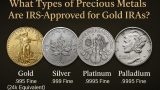
IRA approved precious metals are gold, silver, platinum, and palladium products that meet strict IRS purity standards and must be stored in an approved depository within a self-directed retirement account.
By Gold IRA Custodian Reviews on April 2, 2026
As of 2026, only certain bullion coins and bars qualify under these rules, with eligibility based on purity, production standards, and proper custodial storage.
Not all bullion or coins qualify. To be eligible, metals must meet minimum fineness requirements, be produced by accredited refiners or government mints, and be held in an IRS-approved facility.
Understanding these rules is essential to protect your retirement account from costly mistakes, taxes, or disqualification.
Quick Answer: IRA approved precious metals must meet IRS purity standards, be produced by accredited refiners or government mints, and be stored in an approved depository rather than at home.
IRA Approved Precious Metals Requirements (2026)
In general, the IRS allows investment-grade bullion rather than collectibles. Gold, silver, platinum, and palladium may all qualify, but only when they satisfy specific purity standards and are held properly through a custodian.
| Metal | Minimum Purity | Common IRA-Eligible Examples |
|---|---|---|
| Gold | 99.5% (.995) | American Eagle, American Buffalo, Canadian Maple Leaf, Australian Kangaroo, Austrian Philharmonic |
| Silver | 99.9% (.999) | American Silver Eagle, Canadian Maple Leaf, Austrian Philharmonic |
| Platinum | 99.95% (.9995) | American Platinum Eagle, Canadian Maple Leaf |
| Palladium | 99.95% (.9995) | Canadian Palladium Maple Leaf |
American Gold Eagles are a well-known exception and are permitted even though they do not meet the standard .995 gold purity threshold.
IRS Rules Behind IRA Approved Precious Metals
The IRS governs precious metals IRAs under Internal Revenue Code Section 408(m), which helps define which metals qualify and how they must be handled inside a retirement account.
- Metals must meet minimum purity thresholds
- Coins should generally come from a national government mint
- Bars should come from accredited refiners or assayers
- Assets must be held by a qualified custodian
- Storage must occur in an approved depository rather than at home
These rules are intended to keep precious metals IRAs focused on standardized, investment-grade bullion rather than speculative collectibles.
How IRA Approved Precious Metals Are Verified
IRA approved precious metals are not defined by purity alone. They also need to come from trusted sources and maintain clear verification standards from production through storage.
- Accredited refiners: Bars should come from recognized refiners or assayers
- Assay certification: Each bar or coin should verify weight and purity
- Mint authority: Eligible coins are generally issued by recognized government mints
- Chain of custody: Metals should maintain documented handling from production to storage
These safeguards support authenticity, consistency, and liquidity, which are all important in a retirement account built around physical bullion.
Which Precious Metals Are Allowed in an IRA?
Four precious metals typically qualify for self-directed IRA ownership when they meet the applicable requirements.
- Gold: Usually must meet .995 purity, with limited exceptions
- Silver: Must generally meet .999 purity
- Platinum: Must generally meet .9995 purity
- Palladium: Must generally meet .9995 purity
While the list sounds straightforward, the exact product still matters. Not every coin or bar made from these metals is automatically IRA eligible.
Why American Gold Eagles Are IRA Approved
The American Gold Eagle is one of the most discussed exceptions in the precious metals IRA world.
Although it contains 91.67% gold rather than .995 fine gold, it is explicitly allowed because it is produced by the U.S. Mint and recognized under the applicable retirement account rules.
This is one reason investors should not rely on purity alone when evaluating eligibility. Product type and official recognition matter too.
IRA Approved Coins (Common Examples)
Many investors prefer coins because they are familiar, widely recognized, and often easier to liquidate in smaller increments than larger bars.
- American Gold Eagle
- American Buffalo Gold Coin
- American Silver Eagle
- Canadian Maple Leaf Gold Coin
- Australian Kangaroo
- Austrian Philharmonic
These are among the best-known examples, but eligibility still depends on the exact product and its compliance with IRA rules.
IRA Approved Bullion Bars
Bars are also commonly used in precious metals IRAs, especially by investors who want straightforward bullion exposure with lower premiums relative to many coins.
- Must meet the required purity threshold for the metal
- Must come from accredited refiners or assayers
- Should display proper weight and purity markings
- Often include serial numbers and assay documentation
- Common names include PAMP Suisse, Credit Suisse, and Royal Canadian Mint products
Because bars vary by refiner and format, many investors work closely with their custodian or dealer before purchasing to confirm eligibility.
IRA Approved Coins vs Bars: Key Differences
Both coins and bars can qualify, but they behave a little differently from a practical investment standpoint.
| Feature | Coins | Bars |
|---|---|---|
| Liquidity | Often high | Often strong, depending on size and refiner |
| Premiums | Usually higher | Usually lower |
| Recognition | Very broad | Depends on the refiner and format |
| Flexibility | Convenient for smaller liquidations | Can be efficient for larger allocations |
Why IRA Approved Metals Focus on Investment-Grade Bullion
IRA rules generally favor investment-grade bullion because it is standardized, easier to value, and less vulnerable to the subjective pricing that often surrounds collectibles.
Unlike rare or numismatic coins, bullion is typically priced closer to its underlying metal value. That makes pricing more transparent and liquidation more straightforward when the time comes to rebalance or take distributions.
- Transparent pricing: Closely tied to global spot markets
- Higher liquidity: Easier to recognize and trade
- Lower risk of overpaying: Less collectible markup
- Standardized value: Better aligned with retirement account rules
What Precious Metals Are NOT Allowed in an IRA?
Many products that sound appealing to collectors do not belong in a precious metals IRA.
- Collectible or numismatic coins
- Rare or graded coins
- Many pre-1933 gold coins
- Certain foreign coins that do not meet IRA requirements
- Products that fail purity or sourcing standards
This is one reason due diligence matters. A coin can contain precious metal and still be inappropriate for IRA ownership.
IRS Storage Rules for Precious Metals IRAs
Storage rules are just as important as product eligibility. Even approved metals can become a problem if they are handled incorrectly after purchase.
- Metals must be stored in an approved depository
- Personal possession is generally not allowed
- A qualified custodian must administer the account
- Improper storage may trigger taxes and penalties
That is why precious metals IRAs are built around a custodian-and-depository model rather than direct home possession.
Common Mistakes to Avoid
Investors often run into trouble not because they intended to violate the rules, but because they relied on incomplete or misleading information.
- Buying non-approved coins or bars
- Assuming all bullion qualifies automatically
- Attempting home storage arrangements
- Ignoring purity requirements
- Working with dealers who are vague about compliance
Important: Choosing the wrong dealer can completely undermine an otherwise compliant IRA.
Before moving forward, review this step-by-step guide on how to find a reputable gold dealer to avoid hidden fees, non-approved metals, and costly mistakes.
Is a Precious Metals IRA Right for You?
IRA approved precious metals are often considered by investors who want broader diversification and a tangible asset inside their retirement strategy.
They may appeal especially to those who are concerned about inflation, currency weakness, or overexposure to paper assets alone.
- Those seeking protection against inflation
- Individuals concerned about currency devaluation
- Retirement savers looking to diversify beyond stocks and bonds
- Investors who value tangible, physical assets
That said, precious metals are usually best viewed as one component of a larger long-term retirement plan rather than a complete replacement for every other asset class.
Frequently Asked Questions
What metals are IRA approved?
Gold, silver, platinum, and palladium may be IRA approved if they meet the required purity standards and storage rules.
Can I store IRA gold at home?
No. Precious metals held in an IRA are generally required to remain with an approved custodian and depository rather than in personal possession.
What purity is required for gold in an IRA?
Gold must generally be at least .995 fine, although certain exceptions such as the American Gold Eagle are permitted.
Are silver bars IRA approved?
Silver bars can be IRA approved when they meet the required .999 purity threshold and come from an accredited refiner.
Why are collectible coins usually excluded from precious metals IRAs?
Collectible coins are usually excluded because their value can depend heavily on rarity, grading, and collector demand rather than standardized bullion content.